

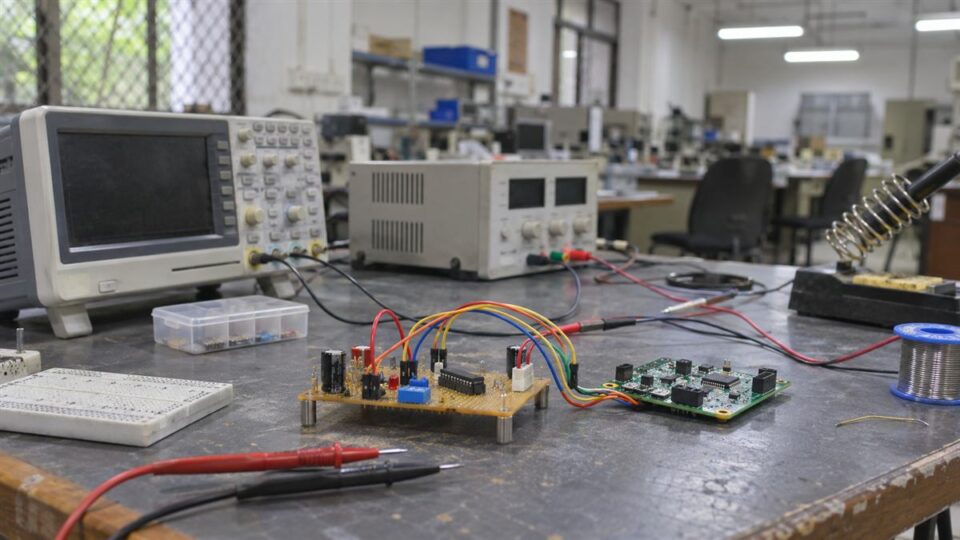
NEW DELHI, November 3 — IIT Delhi has announced a new way to explore its research alongside a report on an Open House that brought students and industry visitors into contact with work across engineering and science.
In an account published on November 2, the institute said its October 31 event featured more than 500 technological presentations. It also announced the launch of Research Ambit, a discovery platform intended to help users find people, papers, intellectual property and research themes.
The IIT Delhi Research Ambit announcement gives the campus showcase a potentially longer life online. A laboratory visit is limited by time and place; a usable research directory can give an interested student or organisation somewhere to begin after the doors close.
Research beyond a single demonstration
The institute reported more than 100 prototype and project demonstrations, over 225 posters, more than 80 laboratory demonstrations and upwards of 90 short student talks. Themes included data science, quantum technologies, semiconductors, robotics, advanced materials, biotechnology and sustainability.
Approximately 3,000 school and college students and more than 1,500 other visitors attended, according to IIT Delhi. These figures are the institute’s account of the event, rather than an independent evaluation of the technologies shown.
That distinction is important when reading a research showcase. The number of presentations describes the scale of participation. It does not establish that every prototype is ready for sale, that every project has completed external testing, or that a demonstration will become a commercial product.
Making expertise easier to find
Research Ambit’s public thematic directory groups work under subjects such as healthcare and medical technology, advanced materials, sustainable infrastructure, manufacturing, communications, energy and climate, and computing.
It offers a subject-based starting point alongside the familiar organisational boundaries of a university. Someone interested in a water, materials or medical-device problem may not know which department to approach. Browsing by theme can make the first search less dependent on knowing an academic’s name.
The platform’s stated role is discovery. Readers should not assume that the presence of a project, paper or intellectual-property reference means that it is available under a particular licence or that a collaboration has already been approved.
For a potential partner, the next questions remain specific: who is responsible for the work, what evidence supports it, what facilities are required, and what stage has the project reached? A directory is useful when it helps those questions reach the right people.
A public route into technical subjects
The Open House website placed the event at the Hauz Khas campus on October 31 and advertised free participation for students and professionals. Its programme included faculty sessions on research using modest computing resources and on computational imaging.
These subjects illustrate why access to explanations matters alongside access to equipment. A visitor looking at a complex device needs to understand the problem being addressed, the assumptions behind the method and the limits of a demonstration.
For school students, a short presentation can also provide a manageable first encounter with a field that otherwise appears mainly as examination material or a degree title. The value lies in seeing how a question becomes an experiment, rather than in treating every display as a finished invention.
What Delhi-NCR readers can take from the announcement
The regional relevance extends to students considering technical study and organisations searching for research expertise. A clearer public map of a campus’s work can help both groups formulate more precise enquiries.
For example, a business investigating a manufacturing problem would need evidence about performance, repeatability and practical costs. A student exploring a research area would need to understand methods, prerequisites and the difference between neighbouring specialisms. Those are different enquiries, even when they begin on the same thematic page.
Neither an event attendance figure nor a platform launch answers those questions automatically. Their practical usefulness depends on the quality and currency of the information, and on whether a visitor can identify an appropriate next step.
The next test is continued usefulness
The November 2 announcement establishes what IIT Delhi says it presented and launched. It does not provide evidence of subsequent licensing deals, commercial deployments or measured outcomes from the discovery platform.
Those would be separate developments requiring their own verification. For now, the news is a substantial public research showcase and an additional route for finding the work behind it. For Delhi-NCR’s students and prospective research partners, the most useful response is to move from a broad subject of interest to a specific, evidence-based question.
