

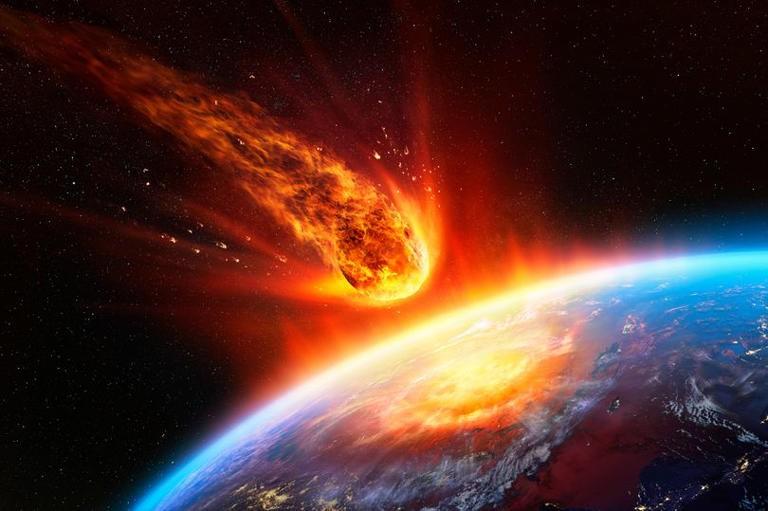
NASA Scientist Warns Thousands of “City-Killer” Asteroids Could Hit Earth — and We’re Not Ready
Washington, D.C. — NASA officials have issued a stark warning that Earth currently has no reliable defence against a large population of undetected asteroids that are capable of destroying entire cities if they were to collide with the planet. These concerns come from senior planetary defence scientists who say the risk is real and pressing, not the stuff of science fiction.
A Blind Spot in Our Planetary Defence
At a recent scientific conference, NASA’s acting Planetary Defense Officer, Dr. Kelly Fast, highlighted a troubling gap in the space agency’s ability to track potentially dangerous near-Earth objects (NEOs).
According to estimates from NASA’s Planetary Defense Coordination Office, there are about 25,000 asteroids at least 140 metres (460 feet) in diameter—large enough to level a city if they hit land. But only around 40% of them have actually been located. Roughly 15,000 remain undetected, meaning their orbits are unknown and they could pass near Earth without warning.
“What keeps me up at night,” Dr. Fast said, “is not the asteroids we know about… it’s the ones out there that we don’t.”
These medium-sized “city killers” are particularly dangerous because they are big enough to inflict severe regional damage, yet small enough that current detection systems struggle to see them against the glare of the Sun or when they follow Earth-like orbital paths.
Why These Asteroids Are Hard to Spot
Detecting asteroids is not straightforward. Many are dark and reflect very little sunlight, making them difficult to pick up with traditional telescopes that rely on visible light. Additionally, objects traveling in orbits similar to Earth’s can stay hidden in the Sun’s glare for long periods, only becoming visible during brief observation windows at dawn or dusk.
Key detection challenges:
-
Dark surfaces: Many asteroids have low albedo (reflectivity), absorbing rather than reflecting light
-
Solar glare: Objects approaching from the Sun’s direction are virtually impossible to see with optical telescopes
-
Orbital similarity: Asteroids in Earth-like orbits move across the sky slowly, blending into background stars
-
Size limitations: Smaller than 140 metres, they pose local threats but are even harder to detect
Dr. Fast stressed that while smaller space rocks enter Earth’s atmosphere frequently—often burning up harmlessly—and very large asteroids have been tracked and catalogued, it is this middle class of rocky bodies that poses the greatest challenge. Their sheer number and unpredictable nature create a substantial blind spot for planetary defence.
Defence Technology Exists — But Isn’t Ready
Ironically, space agencies do have the technology to deflect an asteroid. In 2022, NASA’s Double Asteroid Redirection Test (DART) successfully altered the trajectory of a small asteroid by intentionally crashing a spacecraft into it. The mission proved that it is possible to nudge an asteroid off a collision course—but only when the target is known years in advance.
Despite this success, experts say there is no spacecraft currently in orbit that could be launched on short notice should a threatening asteroid be identified today. Planetary scientist Dr. Nancy Chabot, who worked on the DART mission, has pointed out that while the demonstration was a milestone, it did not leave NASA with an existing, ready-to-deploy asteroid deflection system.
The DART achievement:
-
Successfully changed an asteroid’s orbit
-
Validated kinetic impactor technique
-
Demonstrated international collaboration
-
Provided crucial data for future missions
The current gap:
-
No operational deflection system ready for immediate use
-
Years of warning time still required for any mission
-
Detection remains the primary bottleneck
Efforts Underway to Improve Detection
To address the detection gap, NASA is planning the launch of the Near-Earth Object Surveyor (NEO Surveyor) telescope. Scheduled for launch in the coming years, this space observatory will use infrared sensors to detect the heat signatures of asteroids rather than depending on reflected sunlight—a method expected to significantly improve the discovery of dark and hidden objects.
NEO Surveyor capabilities:
-
Infrared detection unaffected by asteroid darkness
-
Ability to spot objects hidden in solar glare
-
Systematic survey of near-Earth space
-
Expected to find many undiscovered NEOs
NASA’s goal, mandated by U.S. Congress, is to identify at least 90% of NEOs larger than 140 metres. While this objective has made good progress on larger objects, the thousands of mid-sized asteroids remain elusive.
Not an Extinction Threat — But a Serious Regional Danger
Scientists emphasise that these “city-killer” asteroids are unlikely to cause a global mass-extinction event like the rock that wiped out the dinosaurs. However, an impact from an asteroid over 140 metres wide could:
-
Obliterate a large urban centre with direct impact
-
Cause widespread destruction over a region
-
Generate secondary effects including fires and shock waves
-
Create long-term economic disruption
-
Potentially trigger tsunami if ocean impact
Historical context: The 1908 Tunguska event, caused by an asteroid or comet fragment estimated at 50-80 metres, flattened 2,000 square kilometres of Siberian forest. A similar event over a modern city would be catastrophic.
In past monitoring exercises, objects like asteroid 2024 YR4 briefly drew public attention when early observations suggested a small percentage chance of Earth impact in the future, though further analysis eventually ruled out such risks. These episodes underscore both the complexity of asteroid tracking and the importance of improving detection methods.
International Cooperation and Funding
Planetary defence is inherently international. An asteroid doesn’t recognise national borders, and deflection or mitigation would require global coordination. Current efforts involve:
-
NASA leading detection and research
-
ESA contributing with missions like Hera
-
International Asteroid Warning Network sharing data
-
Space Mission Planning Advisory Group coordinating response strategies
However, experts argue that current funding levels are insufficient for the scale of the challenge. Detection systems remain under-resourced, and no dedicated deflection spacecraft are ready for launch.
A Call for Greater Preparedness
NASA scientists and planetary defence experts around the world argue that international cooperation, greater funding, and accelerated deployment of detection systems are crucial to reducing the risk of surprise impacts. Without significant improvements in asteroid detection and monitoring, Earth remains vulnerable to surprises from space—even as technology to deflect threats exists in principle.
Priority actions identified:
-
Accelerate NEO Surveyor launch and similar missions
-
Develop ready-to-launch deflection capability
-
Enhance international data sharing
-
Increase public and political awareness
-
Conduct regular impact exercises
Conclusion: Not Panic, But Preparedness
Ultimately, NASA’s warning is not meant to spark panic, but to highlight that our understanding of the space environment around Earth is incomplete and that planetary defence must continue to evolve before a true emergency arises.
The dinosaurs couldn’t look up. We can. The question is whether we will invest sufficiently in the systems needed to see what’s coming and do something about it.
Fifteen thousand city-killer asteroids remain hidden in the darkness of space. Their orbits carry them near Earth, but we don’t know where or when. Some may never threaten us. Some may be on collision courses we haven’t detected.
The technology to find them exists. The technology to deflect them has been proven. What’s missing is the will to complete the job.
Fifteen thousand reasons to look up. And a warning we should heed.
