

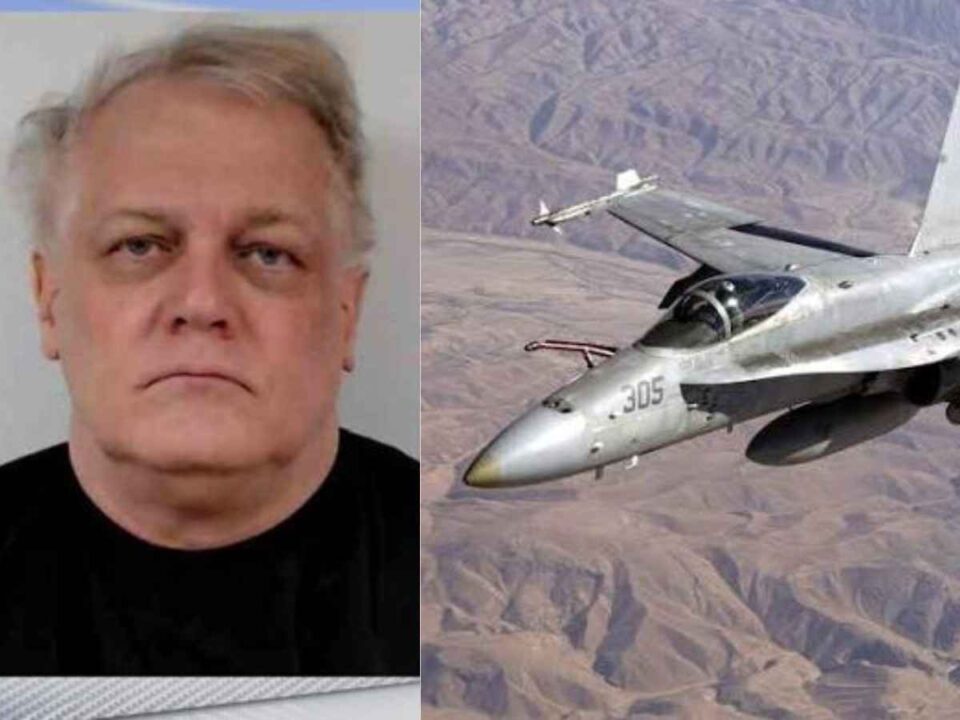
Ex-US Air Force Fighter Pilot Arrested in National Security Case Over China Training
Jeffersonville, Indiana — In a high-profile national security case that has drawn attention across Washington and Beijing, a former US Air Force fighter pilot, Gerald Eddie Brown Jr. , was arrested on Wednesday in Jeffersonville, Indiana, on charges that he illegally trained Chinese military pilots — a move prosecutors say violated strict US laws governing defence expertise and foreign military support, potentially compromising sensitive American military knowledge.
Brown, 65, was taken into custody by US authorities after recently returning from an extended stay in China, where he is alleged to have spent more than two years providing tactical instruction to members of the People’s Liberation Army Air Force (PLAAF) , according to court documents. The arrest, announced by the US Department of Justice, marks one of the more significant recent cases in a series of investigations focused on defence experts accused of sharing sensitive military knowledge with foreign forces considered potential adversaries.
Allegations and Legal Charges
According to the criminal complaint unsealed by federal prosecutors, Brown — a retired Air Force officer with a 24-year career — “willfully conspired” with foreign nationals and US persons to provide combat aircraft training to Chinese military pilots without obtaining the required authorisation from the US government, a serious breach of federal law. Under the Arms Export Control Act (AECA) and International Traffic in Arms Regulations (ITAR) , such training is classified as a defence service and requires a licence from the US State Department before it can be lawfully provided to foreign militaries, regardless of where the training occurs.
Prosecutors say Brown neglected to secure that licence, making his conduct a violation of federal export control laws designed to protect American military advantages. The complaint alleges that Brown began negotiating training arrangements as early as August 2023 and then travelled to China in December 2023 to begin working with PLAAF pilots, continuing his instruction until recently. He remained in China until returning to the United States in early February 2026, apparently believing his actions would escape detection.
Career Background and Expertise
Brown’s military background underscores why federal authorities view the allegations so seriously and why his expertise would be valuable to foreign militaries. During his Air Force service, he commanded sensitive units, oversaw nuclear weapons delivery systems, led combat missions and served as an instructor pilot and simulator instructor on a variety of fighter and attack aircraft, including the F-4 Phantom II, F-15 Eagle, F-16 Fighting Falcon, and A-10 Thunderbolt II — all mainstays of American air power.
In later years, after transitioning to civilian contracting, he also trained US military personnel as a contractor on advanced aircraft such as the F-35 Lightning II, one of the most sophisticated fighters in the world, potentially exposing him to even more sensitive information.
After retiring from active duty in 1996 with the rank of Major, Brown continued his aviation career as a commercial cargo pilot before moving into defence contracting and flight instruction, a role that eventually placed him in demand for advanced pilot training — including, ostensibly, opportunities abroad that brought him to the attention of Chinese military recruiters.
National Security Concerns
US officials have framed the case as part of a broader pattern in which foreign governments — particularly China — have sought to leverage the expertise of former Western military personnel to accelerate the development of their own armed forces and close capability gaps. In public remarks, senior officials from the FBI’s Counterintelligence and Espionage Division have said such activity threatens core US national security interests, undermines military advantages painstakingly developed over decades, and must be met with robust enforcement.
“These allegations reflect a serious breach of trust and a potential compromise of vital military expertise,” said one senior official quoted in the Justice Department’s statement. “Providing US military training to our adversaries without authorisation jeopardises not only American security but also the safety of our service members and allied forces who may one day face opponents trained by our own former personnel.”
Partnership With Intermediaries
The complaint also details how Brown’s arrangements were negotiated through intermediaries, including a Chinese national, Stephen Su Bin, who was previously convicted in the United States in relation to hacking and stealing sensitive military data for the People’s Republic of China, highlighting the organised nature of such efforts. Federal authorities highlighted this connection during the announcement of charges, suggesting a pattern of Chinese efforts to acquire American military knowledge through various means.
Legal Proceedings and Precedent
Brown is expected to appear before a US federal magistrate judge in the Southern District of Indiana on February 26, 2026, where his initial arraignment will take place and charges will be formally presented. If convicted under the Arms Export Control Act and related statutes, he could face significant prison time and possibly civil penalties or forfeitures of any proceeds from the alleged illegal training.
The case bears resemblance to earlier prosecutions, such as that of a former US Marine Corps pilot charged in 2017 for similar conduct but currently fighting extradition, demonstrating that these are not isolated incidents. US authorities have emphasised that such prosecutions are part of ongoing efforts to safeguard military competencies and prevent sensitive training or technological know-how from being transferred to rival military forces without strict oversight.
Broader Implications
Beyond Brown’s individual fate, the case has stirred debate in defence and intelligence circles about how Western military expertise is managed once personnel leave service and move into the private sector, where oversight is less stringent. It has also drawn attention to the increasingly competitive global environment in which China seeks to modernise its military capabilities rapidly, sometimes by seeking out seasoned trainers from abroad willing to share knowledge — a trend US officials have repeatedly warned against.
The case raises questions about whether current laws and enforcement mechanisms are sufficient to prevent such transfers, or whether additional controls are needed.
Conclusion
As the legal process unfolds, the high-profile arrest serves as a warning to others in the defence community about the limits of lawful engagement with foreign military entities and the seriousness with which US authorities view violations of export control and national security laws. For Gerald Brown, a career of service may end with a conviction that brands him as a national security threat.
Ex-pilot arrested. China training alleged. A warning to all who would share American military secrets.
